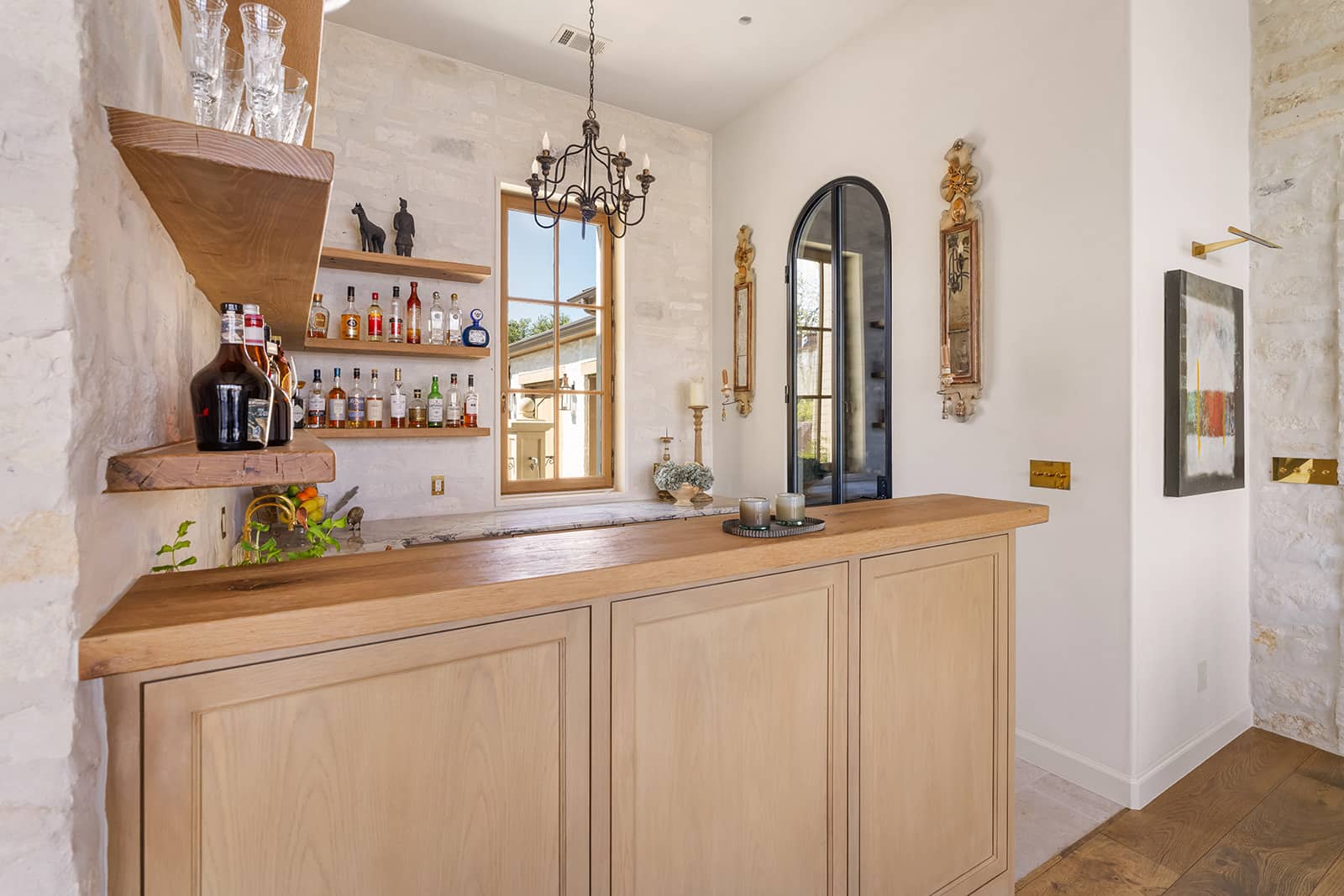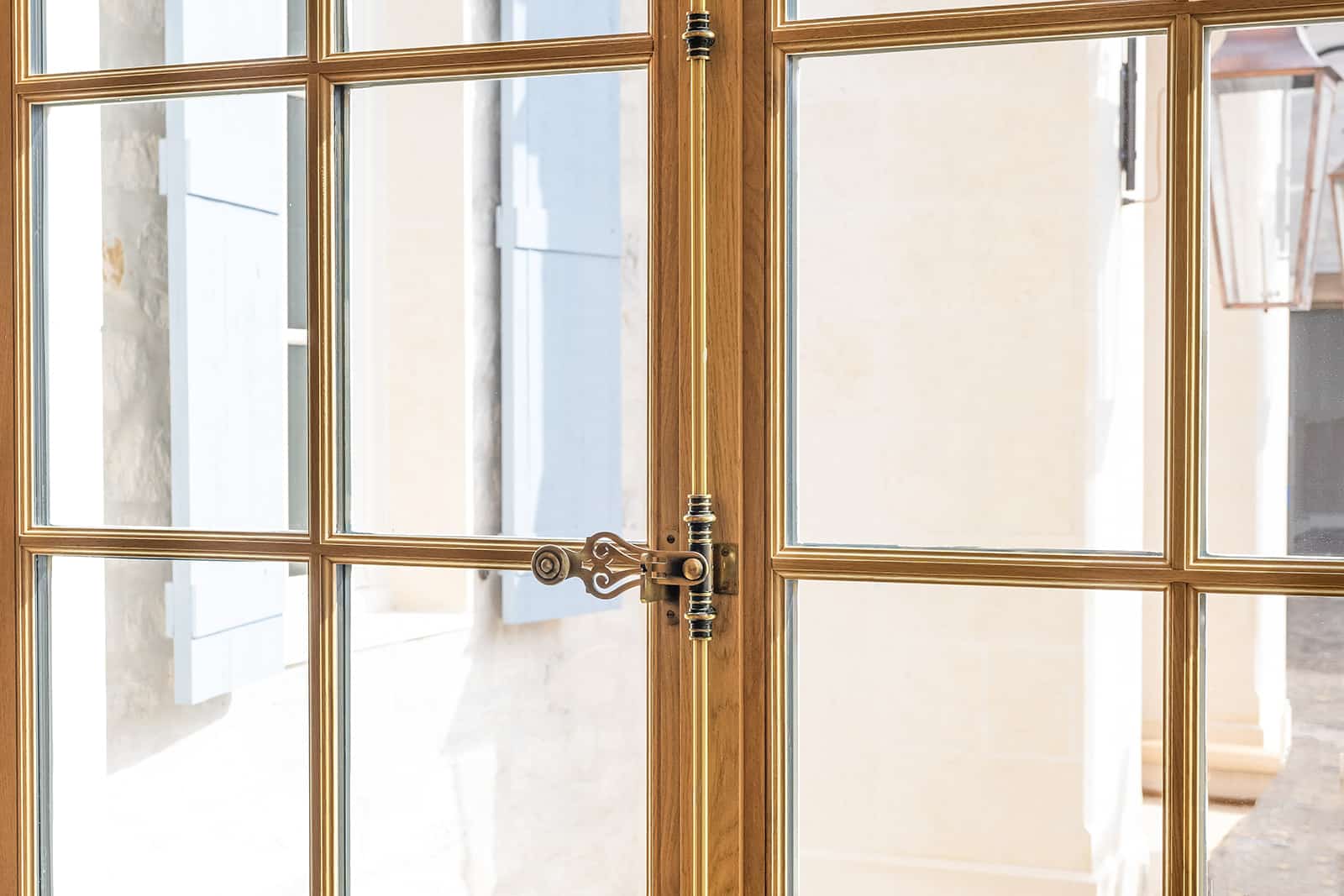
French window hardware includes far more than a handle. Cremone bolts, espagnolettes, hinges, knobs and other fittings determine how a traditional French window operates, while their material, shape and finish contribute to the character of the architecture.
For architects, interior designers and homeowners specifying bespoke French windows, understanding this hardware is part of understanding the window itself. A finely made cremone or espagnolette can reinforce the proportions and period of a design just as much as the timber profile, glazing or finish.
What is French window hardware?
French window hardware refers to the mechanisms and fittings used to operate, secure and support traditional French windows. Common examples include cremone handles and bolts, espagnolettes, hinges, knobs and associated fittings.
Unlike concealed contemporary hardware, much of this hardware remains visible. That makes it both functional and architectural. On a traditional wood window, the handle may become one of the most tactile details in the room.
This is particularly relevant when designing French-style windows for contemporary homes or restoring historic buildings. The objective is not simply to make the window operate. The hardware should also relate to the proportions, materials and architectural language of the opening.
The essential types of French window hardware
French window hardware encompasses several mechanisms, each with its own appearance and method of operation.
Cremone handles and bolts
A cremone, or crémone, is a traditional window locking mechanism operated by a central handle. Depending on the design, operating the handle engages rods at the top and bottom of the window.
The mechanism is especially characteristic of traditional casement windows because the central handle and associated rods remain visible on the face of the window.
Brionne manufactures several styles of cremone handles for windows, including models in steel and brass. Its current range includes different finishes such as aged, satin and polished brass, as well as several steel finishes.
The choice can therefore be highly specific to the architecture. Aged brass creates a different visual relationship with painted timber from patinated steel, while the shape of the handle can reinforce either a traditional or more restrained interpretation.
Espagnolettes
An espagnolette is a traditional French window fastening mechanism based around a vertical rod. When the handle is operated, the mechanism engages the window at its extremities.
Espagnolettes are particularly associated with traditional French joinery and remain relevant for both new bespoke windows and restoration projects.
This ability to adapt the hardware is important when dealing with unusually tall windows, historic proportions or bespoke joinery.
Handles, levers and knobs
The visible point of contact between the user and the window is often the smallest element, but it can have a disproportionate visual impact.
Traditional French window hardware may use a lever, knob or specialized cremone handle. The appropriate choice depends on the window configuration and the architectural character being sought.
Brionne’s catalogue includes different handle families, including France, Manoir, Renaissance and Medieval designs. Its range also includes more restrained and contemporary interpretations.
For a bespoke project, the important consideration is not simply the appearance of an individual handle. Its scale, geometry and finish should make sense alongside the window profile and the other metalwork in the room.
Hinges and other fittings
Hinges, stays, catches and other fittings complete the hardware specification.
They may be less visually prominent than a cremone or espagnolette, but they still need to be coordinated with the sash dimensions, opening configuration and intended use of the window.
On a bespoke window, hardware should therefore be considered early in the design process rather than added after the joinery has already been developed.
Materials and finishes for French window hardware
Material is one of the defining characteristics of traditional French window hardware.
Brionne’s current window hardware range includes steel and brass, with finishes ranging from aged, satin and polished brass to different patinated, sherardized and painted steel finishes.
The choice of finish can be subtle but important.
Aged brass can sit comfortably within a traditional French interior, particularly alongside warm timber and natural stone. Patinated steel can create a quieter, more architectural appearance. A painted finish can allow the hardware to recede into the window rather than becoming a contrasting element.
For architects and interior designers, hardware can therefore be coordinated with door furniture, lighting, cabinetry and other metalwork throughout the project.
Bespoke hardware for traditional French windows
Standard hardware does not always work for a bespoke architectural window.
Window dimensions, sash weight, opening configuration and historical proportions can all require adjustments to the hardware. This is particularly true for large or unusually proportioned windows.
Our approach includes made-to-measure espagnolettes based on technical drawings and client specifications. Its French window range can accommodate different heights and rod diameters, while its hardware is available in multiple materials and finishes.
For Maison Janneau, this flexibility is valuable because bespoke windows are often developed around the architecture rather than selected from a standard dimensional catalogue.
The hardware can consequently be considered as part of the complete window specification.
French window hardware and historic restoration
Historic restoration presents another reason to pay close attention to hardware.
A replacement window may reproduce the general appearance of an original opening but still feel incorrect if the hardware is inconsistent with the building’s period, proportions or existing details.
The National Park Service’s guidance on historic wooden windows emphasizes the importance of evaluating original materials and character-defining features when planning rehabilitation work. Hardware should be considered within this broader architectural context.
Maison Janneau encountered this issue at Château de Nainville, where original hardware was retained and adapted as part of the restoration of the windows. The project demonstrates how existing mechanisms can become part of the specification rather than being treated as disposable accessories.
This approach is particularly relevant to French heritage projects, but the principle also applies to new architecture inspired by traditional French joinery: authenticity often depends on the details.
Brionne: French hardware craftsmanship
The relationship between the window manufacturer and the hardware maker matters when the objective is a genuinely coherent bespoke window.
Brionne is a French manufacturer of hardware for doors, windows and furniture, with 70 years of know-how. Based in Dangé-Saint-Romain in France, the company produces a broad range of architectural hardware, including window cremone handles and espagnolettes.
Its window hardware illustrates the range of possibilities available when traditional mechanisms are treated as manufactured components rather than decorative replicas.
[VIDEO TO COME: Inside the Brionne workshop]
Seeing the hardware being made adds another dimension to the specification. The shape of a handle, the movement of a mechanism and the application of a finish are all part of the final experience of the window.
For Maison Janneau, working with French specialists such as Brionne allows these details to be considered alongside the joinery itself.
Choosing hardware for a bespoke French window
When specifying French window hardware, architects and designers should consider several elements together:
- Window configuration: the hardware must correspond to the opening and locking mechanism.
- Dimensions: unusually large or tall sashes may require bespoke hardware.
- Architectural period: restoration projects may call for historically appropriate forms.
- Material: brass and steel create different visual and tactile qualities.
- Finish: patinated, aged, satin, polished or painted finishes can change the relationship between hardware and joinery.
- Proportion: the size and geometry of the hardware should relate to the window profile.
- Operation: the mechanism should be appropriate for the way the window will be used.
- Coordination: hardware should sit comfortably alongside other metalwork within the architecture.
- Customization: technical drawings and bespoke dimensions may be required for unusual windows.
These decisions are best made during the design of the window rather than at the end of the specification process.
Hardware as part of the architecture
The most successful French window hardware does not feel added to the window. It belongs to it.
A cremone can emphasize the vertical proportions of a tall casement. An espagnolette can reinforce the character of a traditional French opening. A carefully chosen brass or patinated steel finish can connect a window to the wider material palette of an interior.
This is why hardware deserves the same attention as timber species, glazing and finish when specifying bespoke French windows.
Maison Janneau manufactures bespoke wood, steel, bronze and aluminium windows and doors for architectural projects in France and internationally. Hardware can be selected as part of the customization of the window, with traditional French mechanisms particularly suited to the Lafayette and Versailles wood-window ranges. Maison Janneau also offers the possibility of incorporating clients’ own antique hardware where appropriate.
From a restoration in France to a new residence in the United States, the right hardware can provide the small but decisive detail that connects a window to its architecture.
For an upcoming project, Maison Janneau can discuss the appropriate window configuration, hardware, materials and level of customization with the architect, designer or homeowner from the early stages of design.
FAQ
What is French window hardware?
French window hardware refers to the mechanisms and fittings used to operate and secure traditional French windows. Common examples include cremone handles and bolts, espagnolettes, hinges, knobs and other fittings. Unlike much contemporary concealed hardware, these components are often visible, making their material, shape and finish part of the architectural character of the window.
What is a cremone handle?
A cremone handle is a traditional French window handle connected to a locking mechanism. Operating the handle engages the window at multiple points, typically through rods moving toward the top and bottom of the frame. Cremone handles are available in different designs, materials and finishes and are commonly associated with traditional casement windows.
What is an espagnolette?
An espagnolette is a traditional window fastening mechanism based around a vertical rod. When operated, the mechanism engages the window at its extremities. French hardware manufacturers such as Brionne produce espagnolettes in steel and brass, including made-to-measure versions based on technical drawings and specified window dimensions.
What is the difference between a cremone and an espagnolette?
Both are traditional French window mechanisms, but their construction and operation differ. The two mechanisms also have different visual characteristics, so the choice can influence the appearance of a traditional French window.
Can French window hardware be customized?
Yes. Bespoke French window hardware can be adapted to the dimensions and technical requirements of a particular window. For example, French window espagnolettes can be made according to client drawings and specifications, with different height ranges, rod diameters, materials and finishes available.
What materials are used for French window hardware?
Brass and steel are two important materials for traditional French window hardware. We offer window espagnolettes and cremone handles in both materials, with finishes including aged, satin and polished brass and several steel treatments. The appropriate choice depends on the architectural character, window finish and wider interior palette.
Is traditional French hardware suitable for historic restoration?
Yes, provided the hardware is appropriate to the building and the restoration strategy. Existing hardware should be assessed before replacement, particularly when it contributes to the historic character of the window. Traditional mechanisms can sometimes be restored, reproduced or adapted to new bespoke joinery rather than simply replaced with contemporary hardware.
Can traditional hardware be used on new French windows?
Yes. Traditional hardware is not limited to historic buildings. It can be specified on new bespoke French windows when the architectural design calls for traditional proportions, materials or detailing. This is particularly relevant to contemporary residences inspired by French, Provençal or European architecture.
Can Maison Janneau windows use traditional French hardware?
Yes. Maison Janneau offers customization of window hardware and works with traditional French hardware for its bespoke windows. Its wood-window ranges, including Lafayette and Versailles, are particularly suited to projects where traditional French hardware forms part of the architectural design.